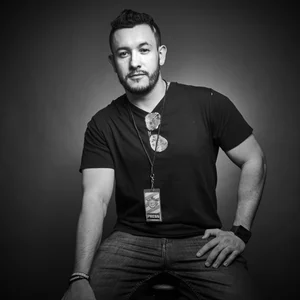
Same clippers. Same guard. Same blend.
Different head, different haircut.
The photo in your pocket
Almost every week, someone sits in my chair, pulls out their phone and shows me a fade. It’s clean and sharp, with a smooth blend from the skin up to the top. Then they say the line I hear all the time: “I want exactly this.”
I’m glad when clients bring photos. A photo shows me what you like faster than any description can. But there’s one thing it can’t show me, and it’s the reason the result is never a perfect copy.
That fade was cut on someone else’s head.
I’ve been cutting hair since 2008. If the chair has taught me one thing, it’s that a fade isn’t a guard number. It’s a shape, and it has to be built on your head, with your hair and your skin tone.
So let me walk you through what I actually look at when you ask for a fade. Once you see it the way a barber does, that photo starts to make a lot more sense.
1. Your head shape is the canvas
Before I pick up the clippers, I look at the shape of your head. Some heads are round at the back, and some are flatter. Many have a ridge, a dip at the crown or a bump behind the ear, and nobody notices them until a fade puts them on display.
A fade follows the curve of your head. That’s why the same blend at the same height can look smooth on one client and uneven on another. The haircut didn’t change. The canvas did.
That’s also why the height of the fade matters so much:
A low fade keeps more weight on the sides and can soften a flat spot.
A mid fade sits well on most head shapes.
A high fade shows more of your head’s shape, for better or worse.
When I pick the height, I’m deciding which parts of your head to show and which to protect.
2. Your hair is the material
Once I know the shape, I look at what I’m working with. Thick hair and fine hair don’t fade the same way, even with the same tools in the same hands.
Dense hair makes a strong, dark shadow through the blend. That’s the look you see in most fade photos online. Finer hair lets more scalp show through, so the same blend reads lighter and softer.
Texture changes the picture too:
Straight hair shows every line, so the blend has to be tighter.
Wavy and curly hair hide small transitions, but the top grows out differently.
Coarse hair holds its shape, while softer hair tends to lie flat.
Think of a tailor working with different fabrics. The pattern can be the same, but wool and linen will never hang the same way.
3. Contrast: the part nobody talks about
This is the one almost nobody thinks about, and it explains a lot of “that’s not my photo” moments. A fade is really a gradient from your hair down to your skin. How that gradient looks depends on how different those two colors are.
Dark hair on lighter skin is high contrast. Every step in the blend shows. The fade looks bold, but it also shows regrowth sooner.
Lighter hair, or hair close to your skin tone, is low contrast. The fade looks softer and more subtle, even when it’s cut just as short.
Neither one is better. But if the person in your photo has a different level of contrast than you do, your fade will never look exactly like theirs.
4. Your hair grows its own way
Contrast is about color. Growth is about direction, and your hair has its own plans. Cowlicks, crown swirls and necklines that grow sideways are all normal, and every one of them changes the fade.
If your crown swirls, a high fade can expose it. If your neckline grows in different directions, the bottom of the fade has to be shaped around it. A good fade works with your growth pattern instead of fighting it.
When a client tells me “it looked different in the photo,” this is often where the difference starts.
5. Your hairline sets the frame
The back and sides are only half the story. The front of a fade has to connect to your hairline, your temples and your sideburns.
A strong, straight hairline frames a fade one way, and temples that sit further back frame it another. Neither is wrong. But the shape around your temples and ears changes how the whole haircut reads.
That’s why I cut the fade to your frame, not to the one in the picture.
6. Your fade has a timeline
A photo captures one moment, usually the best one. Every fade looks its sharpest the day it’s cut. How it looks in week two or three depends on how fast your hair grows and how much contrast you have.
We wrote a full post on that: Why Your Haircut Looks Good Week One — But Not Week Three. And if you’re still deciding between a fade and a taper, start with Taper vs Skin Fade: Choosing the Right Haircut for Your Lifestyle.
How we build a fade that fits you
Put those six together, and you can see why I don’t just reach for a guard when you ask for a fade. At FitBarber Studio, we look at:
The shape of your head, front, sides and back
How dense your hair is, and its texture
The contrast between your hair and your skin
Where your hair grows in different directions
Your hairline and temples
How often you’ll realistically come back in
Then we decide how high the fade sits, how tight the blend is and how it connects to the top. That’s what we mean by Sartorial Grooming: a haircut tailored to you, not copied from a picture.
How to get the most out of your photo
None of this means you should stop bringing photos. Bring them, because they help. Just add a few words that tell your barber what you love about it:
What caught your eye: the height, the sharpness or the length on top
How often you plan to come in
Whether you want it bold or more subtle
Now your barber has something to build on, not just something to copy.
The bottom line
Your fade doesn’t look like your friend’s because your head isn’t your friend’s. That’s not a problem. That’s the whole point of a good haircut.
The best fade isn’t the one in the photo. It’s the one built for your head.
Ready for a fade that’s built for you?
Book your haircut at FitBarber Studio in Chester, NJ. We’ll start with your head shape, your hair and your routine, then build the fade from there.